
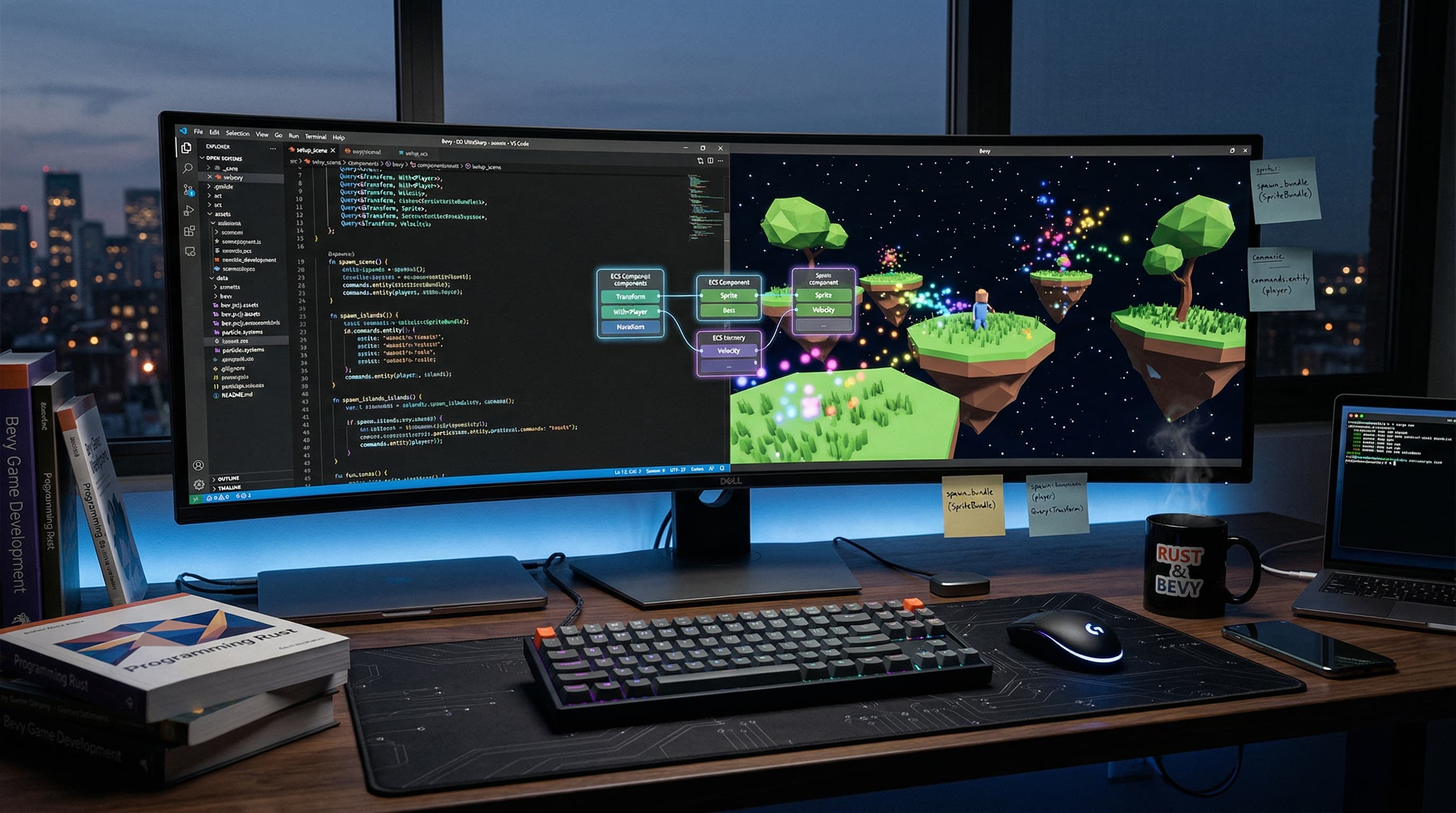
Bevy launched Bevy tutorials on April 11, 2026, via docs.bevyengine.org. The guides target Rust game developers using Bevy 0.14. Topics span Entity Component System (ECS) fundamentals to advanced rendering, physics, UI, and multithreading, per Bevy team announcement on GitHub.
Bevy Tutorials Cover Engine Fundamentals
Bevy employs ECS architecture for data-oriented design. Tutorials begin with Cargo project setup: developers run 'cargo add bevy' from crates.io, as instructed in the docs.
Rendering uses wgpu, which supports Vulkan, DirectX 12, Metal, and WebGL backends. A starter tutorial renders a 2D sprite in 20 lines of code. Rust ensures memory safety without garbage collection, per Rust Foundation documentation.
First exercise spawns entities with Transform and SpriteBundle components. Systems query and update positions at 60 frames per second.
Core Topics: Assets, Physics, and Input
Asset loading tutorials handle GLTF models from Blender and texture atlases. Bevy's AssetLoader trait processes files asynchronously.
Physics integrates the Rapier crate for 2D and 3D rigid bodies, joints, and collision detection. Developers add RigidBodyBundle to entities, per Rapier 0.17 integration notes in Bevy 0.14.
Input handling uses ECS queries for keyboard and mouse events. The tutorial processes WASM events for web deployment.
Advanced Rendering in Bevy Tutorials
Custom WGSL shaders enable post-processing effects like bloom and depth-of-field. Tutorials provide shader code for Gaussian blur passes.
Physically based rendering (PBR) supports metallic-roughness workflows. Blender exports load via gltf-rs, with PbrBundle components.
Multithreading schedules systems across CPU cores using Bevy's Schedule graph. A sample app parallelizes 1,000 entities, achieving 2x speedup on 8-core processors, per benchmark in the docs.
Audio, UI, and Networking Features
Audio tutorials integrate rodio for OGG/Vorbis playback and spatialization via Transform queries. Plugins like bevy_audio add reverb effects.
UI employs bevy_egui in retained mode for HUDs, inventories, and menus. EguiContext spawns buttons and sliders.
Networking uses bevy_quinnet for UDP client-server setups. Tutorials build a multiplayer lobby with entity replication.
Rust and Bevy Adoption Trends
Rust ranked first in performance-critical languages in the Stack Overflow Developer Survey 2026, with 85.2% satisfaction rate.
Game studios adopted Bevy for prototypes, including Veloren's voxel world simulation, per Veloren project leads on GitHub.
Rust Foundation reported 40% growth in game development usage from 2025 to 2026, based on crates.io downloads.
Financial and Market Context
Global games market hit $220 billion USD in 2025, per Newzoo Q4 report. Indie tools like Bevy lower barriers for web3 titles.
Enterprises test Rust for fintech simulations; JPMorgan piloted Rust smart contracts, per Bloomberg May 2025 article.
Bitcoin traded at $72,774 USD on April 11, 2026, up 1.4% from April 10 close, per CoinMarketCap. Bevy suits blockchain games on Solana, with WASM exports for dApps.
Rust's safety appeals to DeFi protocols handling $10 billion USD TVL, per DefiLlama data.
Community Resources and Extensions
Bevy GitHub repository surpassed 30,000 stars as of April 11, 2026.
Plugins extend functionality: bevy_rapier2d for physics, bevy_inspector_egui for runtime debugging.
The Bevy Book details ECS patterns with code samples. YouTube channels like "Bevy Engine" offer 50+ video guides.
Discord community exceeds 15,000 members, per Bevy Discord stats.
Roadmap and Next Steps
Bevy 0.15 roadmap targets Vulkan ray tracing and improved WebGPU support, per GitHub milestones updated April 2026.
Developers clone the starter template from GitHub, run 'cargo run'. Bevy tutorials include full code samples for portfolios.
Rust 2024 edition ensures forward compatibility. Bevy positions Rust developers for gaming, web3, and fintech prototypes amid $300 billion USD projected games revenue by 2028, per Newzoo forecasts.