By [Your Name], Senior Tech Journalist | December 5, 2022
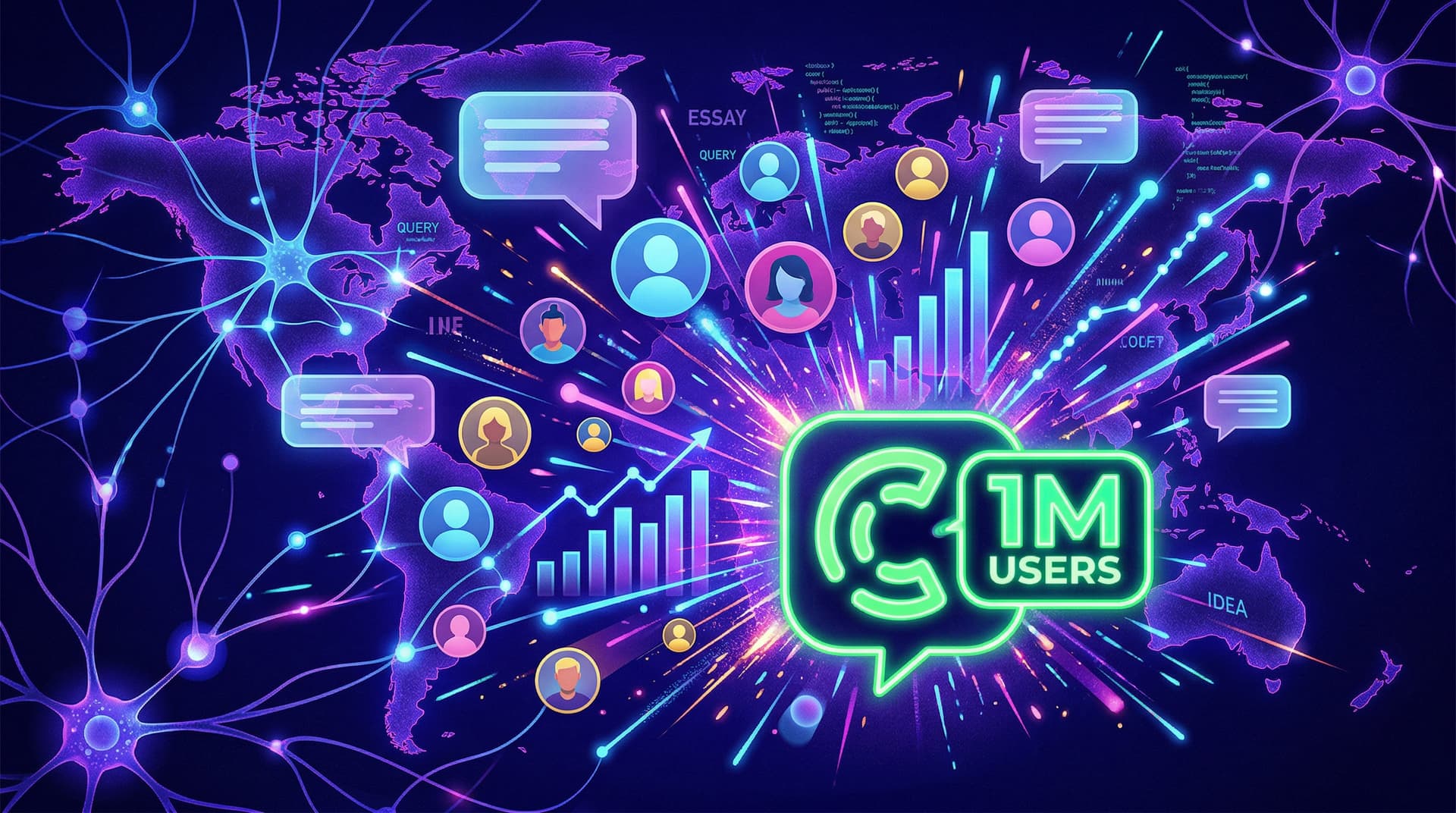
In a stunning display of the transformative power of artificial intelligence, OpenAI's ChatGPT has achieved a milestone that few could have predicted: one million users in just five days. CEO Sam Altman shared the news on Twitter today, simply stating, "chatgpt has reached 1m users in 5 days. wow."
Launched on November 30, 2022, ChatGPT—a conversational AI powered by OpenAI's latest GPT-3.5 model—has captivated users worldwide with its ability to generate human-like responses, write code, answer complex questions, and even compose poetry. This rapid ascent marks it as the fastest-growing consumer application in history, surpassing even social media giants like TikTok, which took nine days to hit the same mark after its U.S. launch.
The Rise of ChatGPT: From Experiment to Phenomenon
ChatGPT is built on the foundations of OpenAI's Generative Pre-trained Transformer (GPT) series, specifically an optimized version of GPT-3.5. Unlike previous models that were largely confined to developer APIs or enterprise use, ChatGPT is freely accessible via a simple web interface at chat.openai.com. Users sign up with an email, and within seconds, they're engaging in dynamic conversations with the AI.
The model's training on vast internet datasets enables it to handle a dizzying array of tasks. Need help debugging Python code? ChatGPT can suggest fixes. Writing a business email? It drafts polished versions. Explaining quantum physics to a child? It simplifies without dumbing down. This versatility has fueled viral sharing on social media, with screenshots of witty exchanges flooding Twitter, Reddit, and LinkedIn.
OpenAI, founded in 2015 by Elon Musk, Sam Altman, and others with a mission to ensure AGI benefits humanity, has iterated rapidly on large language models. GPT-3, released in 2020, was a game-changer with 175 billion parameters, but access was paywalled. ChatGPT democratizes this tech, available for free with optional paid upgrades for heavier usage.
Record-Breaking Growth: What It Means
Altman's announcement comes amid server strain reports, with OpenAI implementing waitlists during peak hours. The one-million-user mark isn't just a vanity metric; it signals unprecedented demand for generative AI. For context:
- Instagram: 2.5 months to 1 million.
- TikTok: 9 days.
- ChatGPT: 5 days.
This pace reflects broader trends in AI adoption. The COVID-19 pandemic accelerated digital tool usage, and now, post-pandemic curiosity about AI is exploding. Tools like DALL-E for images and GitHub Copilot for code have paved the way, but ChatGPT's chat interface lowers the barrier to entry dramatically.
Industry analysts are buzzing. Andrej Karpathy, former Tesla AI director, tweeted his amazement at ChatGPT's capabilities, calling it "the most impressive demo of a language model I've seen." Even skeptics acknowledge its prowess, though debates rage on hallucinations (fabricated facts) and ethical concerns like bias in training data.
Implications for AI and Machine Learning
Accelerated Innovation
ChatGPT's success pressures competitors. Google, with its LaMDA model, is reportedly rushing Bard, a similar chatbot. Microsoft, OpenAI's key backer via a $10 billion investment earlier this year, integrates GPT tech into Bing and Office. Amazon and Meta are scaling their own LLMs.
This arms race could yield rapid advancements in natural language processing (NLP), reinforcement learning from human feedback (RLHF)—key to ChatGPT's polish—and multimodal AI combining text, images, and voice.
Economic and Societal Shifts
At 1 million users, ChatGPT is still nascent, but projections suggest tens of millions soon. Businesses eye it for customer service, content creation, and R&D. Freelance writers and programmers worry about job displacement, yet many see augmentation: AI handles rote tasks, humans focus on creativity.
Regulatory scrutiny looms. The EU's AI Act classifies high-risk systems, and U.S. lawmakers discuss oversight. OpenAI emphasizes safety, with built-in moderation to block harmful content.
Technical Underpinnings
For ML enthusiasts, ChatGPT exemplifies scaling laws: bigger models + more data + compute = better performance. Trained on 570GB of filtered text (about 300 billion tokens), fine-tuned via RLHF where humans rank responses, it achieves state-of-the-art on benchmarks like MMLU.
Challenges persist: high inference costs (GPUs galore), environmental impact (training emits CO2 equivalent to hundreds of flights), and alignment—ensuring AI values match human ones.
User Stories and Early Impact
Anecdotes abound. Students use it for homework help, teachers for lesson plans. Developers prototype apps via natural language prompts. One viral thread showed ChatGPT passing a mock bar exam with 80% accuracy.
On Reddit's r/MachineLearning, users dissect its architecture, praising the InstructGPT lineage for instruction-following prowess.
Looking Ahead
OpenAI plans mobile apps and API access soon, per Altman. With Azure backing, scalability improves. But sustaining growth demands innovation amid competition.
ChatGPT's milestone isn't just numbers—it's proof AI has entered mainstream consciousness. As Altman noted, "wow" indeed. The AI era accelerates; buckle up.
CSN News covers the intersection of technology and society. Follow for updates on this story.
(Word count: 912)