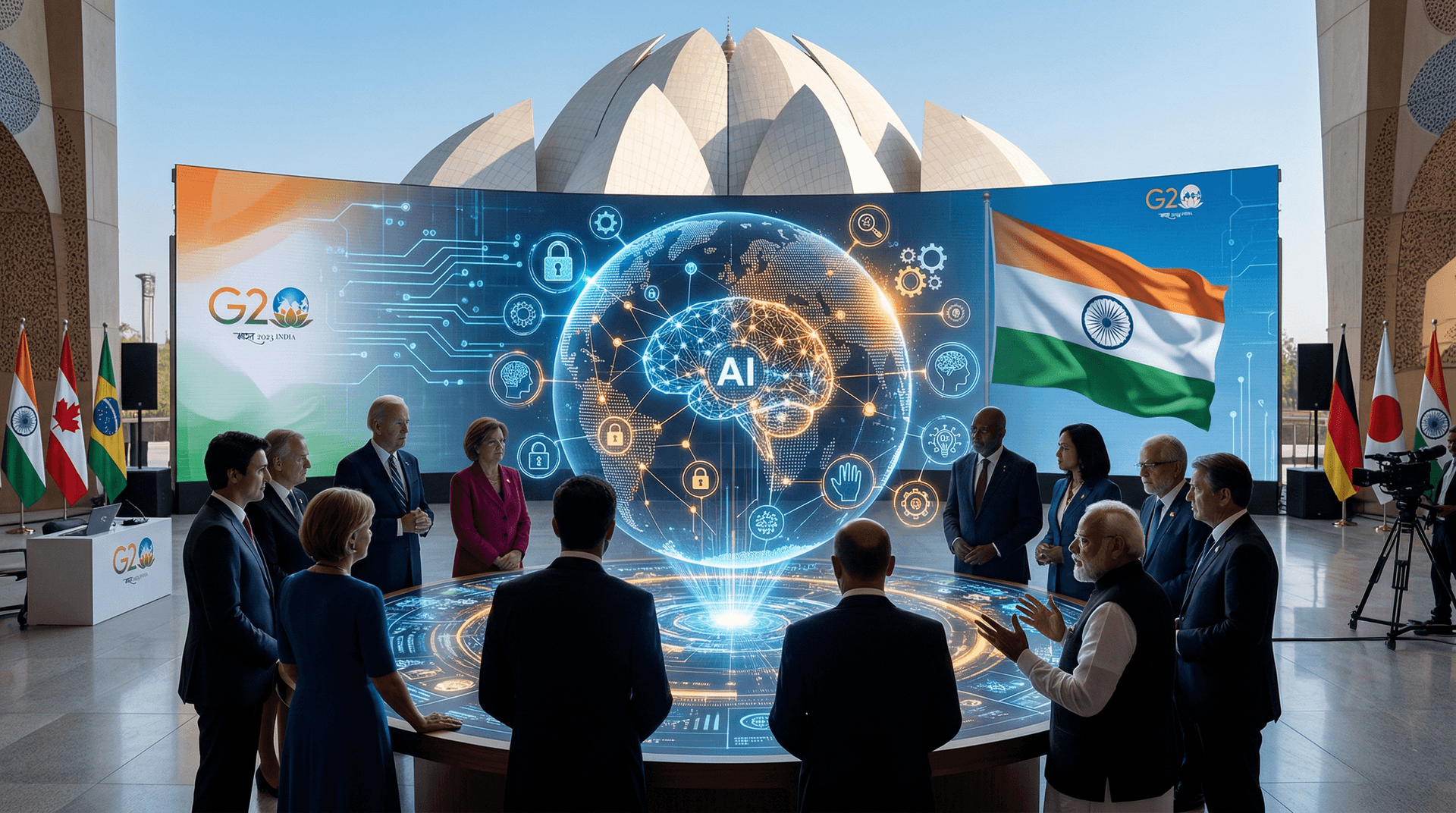
New Delhi, September 12, 2023 – As the curtains fell on the G20 Summit in New Delhi on September 10, leaders from the world's major economies united behind the 'New Delhi Leaders’ Declaration.' This comprehensive document marks a pivotal moment for artificial intelligence (AI) and machine learning, setting the stage for collaborative global governance amid rapid technological advancement.
Hosted by India under Prime Minister Narendra Modi, the summit gathered representatives from 43 nations, including U.S. President Joe Biden, Chinese Premier Li Qiang, and European Commission President Ursula von der Leyen. Amid discussions on climate change, economic recovery, and geopolitical tensions, AI emerged as a central theme, reflecting its transformative impact across sectors from healthcare to finance.
Key AI Commitments in the Declaration
The declaration explicitly addresses AI's dual-edged nature: immense opportunities for sustainable development juxtaposed against risks like bias, misinformation, and job displacement. Key provisions include:
- Strengthening International Cooperation: G20 members pledged to enhance multilateral dialogue on AI standards, capacity-building, and equitable access. This builds on prior frameworks like the OECD AI Principles and UNESCO's AI Ethics Recommendation.
- Risk Mitigation and Safety: Emphasis on developing robust mechanisms to address AI-related risks, including transparency in algorithms, human oversight, and resilience against adversarial attacks. The text calls for "responsible and human-centric" AI deployment.
- Inclusive Digital Public Infrastructure (DPI): Promoting open, interoperable DPI powered by AI to bridge the digital divide, with a focus on emerging markets. India's UPI and Aadhaar systems were cited as models.
- Sustainable Development Goals (SDGs): Harnessing AI for climate action, poverty alleviation, and health, while ensuring alignment with SDGs.
Prime Minister Modi hailed the declaration as a "consensus document reflecting the spirit of 'One Earth, One Family, One Future' (Vasudhaiva Kutumbakam)." In his closing remarks, he underscored AI's role in India's digital revolution, positioning the country as a leader in ethical AI innovation.
Implications for the AI Industry
For tech giants like Google, Microsoft, and OpenAI, the G20 outcomes signal regulatory headwinds and opportunities. Companies investing billions in large language models (LLMs) and generative AI – such as GPT-4 and Llama 2 – now face pressure to prioritize safety and ethics.
"This declaration is a wake-up call for the AI sector," said Dr. Fei-Fei Li, co-director of Stanford's Human-Centered AI Institute. "It underscores the need for global norms that prevent a fragmented regulatory landscape, much like GDPR did for data privacy."
In finance, AI-driven fintech applications stand to benefit from standardized DPI. JPMorgan Chase and others have already integrated machine learning for fraud detection and personalized banking, but the declaration's focus on cybersecurity could spur further investments.
Machine learning researchers hailed the nod to open-source collaboration. Initiatives like Hugging Face's model hub and EleutherAI's efforts align with calls for shared knowledge to democratize AI.
Geopolitical Context and Challenges
The summit's success came despite U.S.-China frictions over AI chip exports. The Biden administration's restrictions on advanced semiconductors to China, aimed at curbing military AI applications, loomed large. Yet, the declaration's consensus – achieved after intense negotiations – demonstrates diplomacy's potential.
Developing nations, represented by the African Union (newly inducted as a permanent G20 member), pushed for technology transfer. Brazil's incoming G20 presidency vowed to prioritize "Global South" perspectives in 2024.
Critics, however, argue the document lacks enforceable mechanisms. "Bold words, but where's the teeth?" tweeted AI ethicist Timnit Gebru. Without binding treaties, implementation may vary, echoing Paris Agreement challenges on climate.
Spotlight on India's AI Leadership
India's role was instrumental. With over 800 million internet users and AI startups like Sarvam AI and Krutrim, the nation is ramping up. The National AI Strategy 2.0, launched earlier in 2023, focuses on vernacular language models and agriculture AI.
At the summit, Modi announced expanded IndiaAI Mission funding to $1.2 billion, targeting compute infrastructure and skilling 1 million developers. "AI for All" became the mantra, resonating with G20 peers.
Broader Tech Ecosystem Impact
The declaration intersects with machine learning's frontiers:
- Generative AI Boom: Post-ChatGPT, tools like Midjourney and Stable Diffusion raise copyright and deepfake concerns. G20's transparency push could inspire watermarking standards.
- Edge AI and IoT: With 5G rollout, on-device ML for privacy-preserving inference gains traction.
- Healthcare ML: Models like Google's Med-PaLM exemplify AI's diagnostic potential, aligned with SDG health goals.
Venture capital flows into AI remain robust, with $50 billion invested globally in H1 2023, per Crunchbase. The G20 framework may boost investor confidence in regulated markets.
Looking Ahead
As AI capabilities accelerate – evidenced by recent releases like Meta's Code Llama and Google's PaLM 2 updates – the New Delhi Declaration provides a roadmap. Upcoming forums, including the UN's Global Digital Compact, will build on this momentum.
For policymakers, innovators, and citizens, the message is clear: AI's promise demands collective stewardship. The G20's unity offers hope in an era of technological disruption.
CSN News will continue monitoring AI policy developments.
(Word count: 912)