Mountain View, CA – October 4, 2023 – In a dazzling display of artificial intelligence prowess, Google unveiled its latest Pixel 8 and Pixel 8 Pro smartphones at the annual Made by Google event, brimming with machine learning innovations designed to redefine mobile photography, video editing, and everyday user interactions. Simultaneously, the company rolled out major updates to its Bard AI chatbot, integrating advanced image generation capabilities powered by Imagen 2, signaling an intensified battle in the AI arms race against competitors like OpenAI and Microsoft.
Pixel 8 Series: AI at the Core
At the heart of the Pixel 8 lineup is Google's custom Tensor G3 processor, a significant leap forward in on-device AI processing. Fabricated on a more efficient 4nm process by Samsung, the Tensor G3 boasts improved performance, better power efficiency, and enhanced security features through the Titan M2 chip. But it's the AI-centric capabilities that stole the show.
Magic Editor: Generative AI for Photos
One of the standout features is Magic Editor, an evolution of the existing Photo Unblur and Magic Eraser tools. Powered by generative AI models similar to those in Google's experimental ImageFX tool, Magic Editor allows users to not just remove objects from photos but to intelligently reposition, resize, or even add new elements. Imagine moving a subject from one side of the frame to another, with the background seamlessly filling in via generative fill technology. Google emphasized that these edits maintain photorealism, leveraging diffusion models trained on vast datasets to avoid uncanny valley effects.
This isn't mere gimmickry; it's built on years of research in generative adversarial networks (GANs) and diffusion models, areas where Google DeepMind has been a pioneer. Early demos showed users effortlessly changing the time of day in photos or expanding horizons, tasks that previously required desktop software like Adobe Photoshop.
Best Take and Audio Magic Eraser
For group photos, Best Take uses machine learning to analyze multiple shots and composite the best facial expressions from each participant onto a single image. The AI identifies faces, matches poses, and blends expressions with sub-pixel accuracy, reducing the frustration of blink-and-you-miss-it group selfies.
Complementing this is Audio Magic Eraser for videos, which employs audio source separation models to isolate and remove unwanted sounds like wind, crowds, or children's voices. Drawing from techniques in acoustic signal processing and neural audio synthesis, this feature lets creators focus on the main audio track, making it a boon for vloggers and social media enthusiasts.
Video Boost and Night Sight Video
Video Boost takes AI processing to the cloud, where the Pixel 8 Pro sends footage for server-side enhancements. Using computational photography pipelines enhanced by machine learning, it improves lighting, reduces noise, and upsamples resolution to 8K. Night Sight Video extends low-light capabilities to motion, stabilizing shaky footage with AI-driven optical flow estimation.
These features are underpinned by the Tensor G3's dedicated AI accelerators, capable of up to 35 trillion operations per second (TOPS) for inference tasks, putting it on par with emerging neuromorphic computing trends.
Bard Gets a Multimodal Makeover
Beyond hardware, Google turned attention to software with Bard updates. Now integrating Imagen 2, Google's state-of-the-art text-to-image diffusion model, Bard can generate high-fidelity images from prompts in 70 languages. Imagen 2 improves upon its predecessor with better text adherence, photorealism, and safety filters to prevent harmful content generation.
A key demo highlighted Bard creating diverse visuals, from abstract art to realistic scenes, rivaling Midjourney and DALL-E 3. This rollout comes amid Bard's expansion to over 40 languages for chat, powered by PaLM 2 large language model (LLM).
Circle to Search: Revolutionizing Discovery
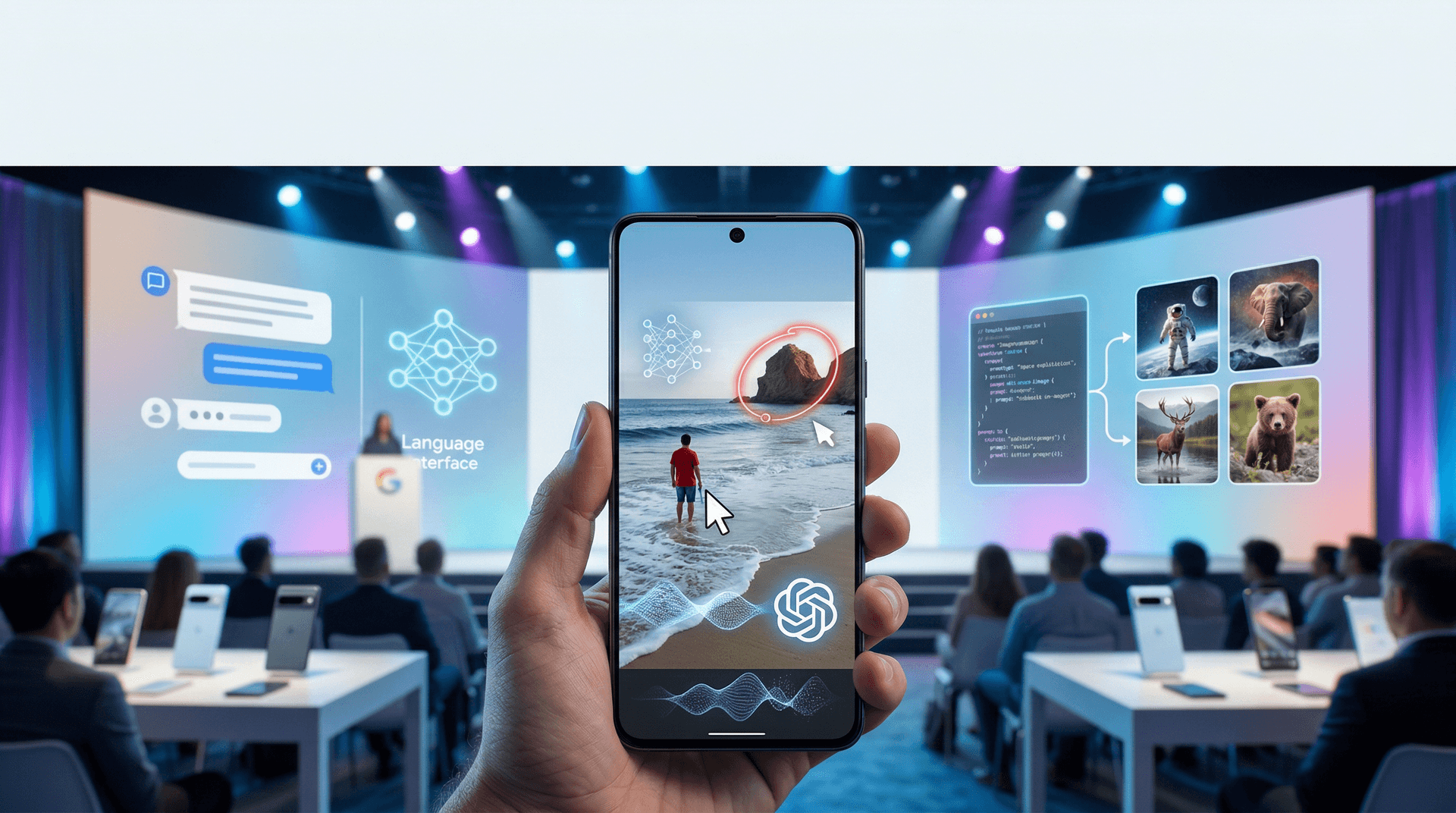
Perhaps the most innovative is Circle to Search, merging Google Lens with AI search. Users can circle anything on their Pixel 8 screen—be it text, images, or videos—and get instant contextual results without leaving the app. Built on multimodal LLMs that process visual and textual queries jointly, this feature exemplifies zero-shot learning, where models generalize across domains without task-specific training.
Available first on Pixel 8 devices and select Samsung Galaxy phones, Circle to Search could disrupt traditional search paradigms, making information retrieval more intuitive.
Competitive Context and Future Implications
Google's announcements arrive at a pivotal moment. With OpenAI's GPT-4 powering Microsoft Copilot and Anthropic's Claude gaining traction, Alphabet is under pressure to deliver. CEO Sundar Pichai framed these as steps toward 'AI-first' experiences, echoing the company's I/O 2023 promises.
The Pixel 8 starts at $699 for the 128GB model, with pre-orders live and shipping October 12. Pricing undercuts Apple's iPhone 15 Pro while offering more aggressive AI integration.
Experts praise the on-device focus, citing privacy benefits over cloud-reliant rivals. Dr. Fei-Fei Li, a pioneer in computer vision, noted in a recent interview that edge AI like Tensor G3 could democratize advanced ML, reducing latency and data transmission risks.
However, challenges remain. Tensor chips have lagged Qualcomm's Snapdragon in raw benchmarks, and generative AI raises ethical questions around deepfakes. Google promises watermarking for Magic Editor outputs and human oversight in model training.
Broader AI Ecosystem Push
Google also teased Android 14's AI enhancements, like real-time translation in calls via Pixel Stand. Fitness tracking on Pixel Watch 2 gains Loss of Pulse Detection using ML on heart rate variability.
Looking ahead, whispers of Project Starline (3D teleconferencing) and more DeepMind integrations suggest 2024 will bring even bolder ML applications.
In summary, Google's October 4 event positions it as a formidable AI contender. By embedding machine learning into consumer devices and chatbots, it's not just catching up—it's aiming to lead. As the AI race accelerates, users can expect smarter, more creative tools that blur the line between human ingenuity and silicon smarts.
CSN News will continue covering AI developments as they unfold.
(Word count: 912)