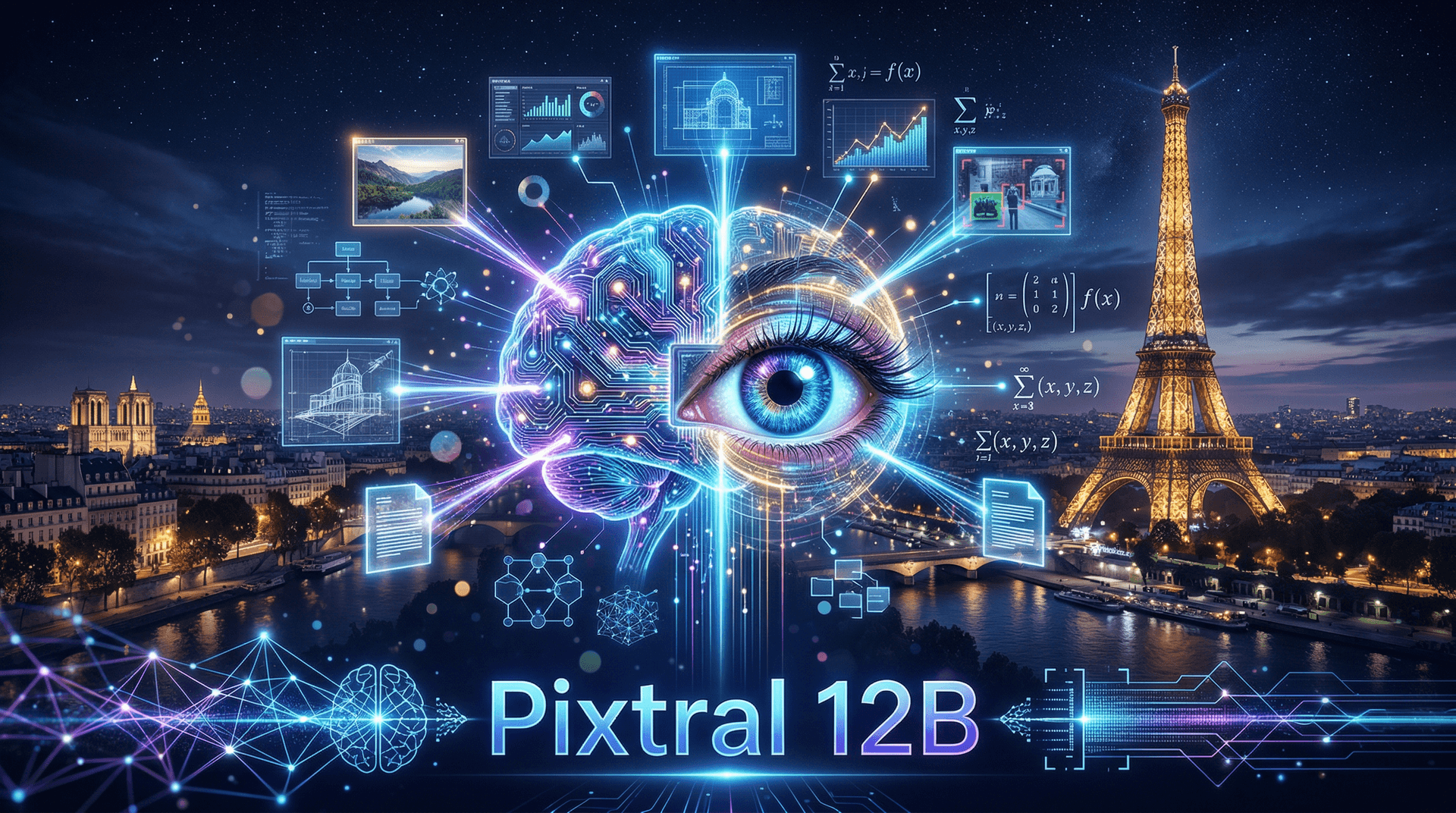
Paris, December 20, 2024 – In a bold move that underscores Europe's growing clout in the artificial intelligence arena, French startup Mistral AI has launched Pixtral 12B, its inaugural open-weight multimodal model. Released on December 12, this 12-billion-parameter vision-language powerhouse is already turning heads with its superior performance on industry benchmarks, challenging the dominance of American tech behemoths like OpenAI and Meta.
Mistral AI, founded in 2023 by former Google DeepMind and Meta researchers Arthur Mensch, Guillaume Lample, and Timothée Lacroix, has rapidly ascended as one of Europe's most promising AI startups. With previous funding rounds totaling over €1 billion—including a landmark €385 million Series A in December 2023 at a €2 billion valuation—the company has positioned itself as a key player in the generative AI race. Pixtral 12B marks a pivotal expansion from Mistral's text-only models like Mistral Large and Mixtral, venturing into the lucrative multimodal domain where models process both text and images.
Breaking Down Pixtral 12B: Capabilities and Benchmarks
At its core, Pixtral 12B is a multimodal large language model (MLLM) trained on a massive dataset of interleaved image-text documents. It supports a context window of up to 128,000 tokens and can handle images as large as 1 megapixel (1024x1024 pixels), making it adept at analyzing high-resolution visuals, complex documents, charts, and photographs.
Key features include:
- Advanced OCR and Document Understanding: Excels at extracting text from invoices, forms, and handwritten notes with high fidelity.
- Visual Reasoning: Solves math problems from images, interprets diagrams, and answers questions about real-world scenes.
- Object Detection and Captioning: Identifies multiple objects in images and generates detailed descriptions.
- Open Weights: Released under the Apache 2.0 license, available immediately on Hugging Face for developers worldwide.
On benchmarks, Pixtral 12B punches above its weight class. It achieves state-of-the-art results among open-weight models:
| Benchmark | Pixtral 12B Score | Closest Competitor | |-----------|-------------------|--------------------| | MMMU (Val) | 60.5% | Llama 3.2 11B (53.5%) | | MMMU-Pro | 47.6% | Llama 3.2 11B (40.5%) | | MathVista | 71.7% | Llama 3.2 11B (59.4%) | | DocVQA | 94.6% | PaliGemma 3B (90.6%) | | ChartQA | 88.8% | InternVL2-26B (84.6%) |
These scores position it ahead of Meta's Llama 3.2 Vision 11B and 90B in several categories, despite being smaller and fully open-source. Mistral claims it rivals proprietary models like GPT-4V in select tasks, though independent verification is ongoing.
Strategic Implications for AI Startups
The launch comes at a critical juncture for AI startups. Multimodal models are the next frontier, powering applications in e-commerce (visual search), healthcare (medical imaging), autonomous vehicles (scene understanding), and enterprise software (document automation). By open-sourcing Pixtral 12B, Mistral democratizes access, fostering an ecosystem around its technology while gathering valuable feedback for future iterations.
"Pixtral is our first step into multimodal AI, but not the last," said Arthur Mensch, Mistral co-founder and CEO, in a blog post. "We believe open models are key to accelerating innovation globally."
For startups, this means lower barriers to entry. Developers can fine-tune Pixtral on platforms like Hugging Face or integrate it via Mistral's API (La Plateforme), which offers pay-as-you-go pricing. Early adopters include French enterprises and international researchers, with potential for rapid proliferation.
Europe's AI Ambitions vs. U.S. Dominance
Mistral's feat highlights Europe's push to counter U.S. AI hegemony. Backed by investors like Lightspeed Venture Partners, Andreessen Horowitz, and Nvidia, the startup benefits from France's AI Action Summit initiatives and EU funding. President Emmanuel Macron has championed Mistral as a national champion, even personally investing.
Yet challenges persist. U.S. firms like OpenAI (with GPT-4o) and Google (Gemini) hold vast compute resources and proprietary data troves. Mistral counters with efficiency—Pixtral was trained on a modest cluster compared to GPT-4's rumored scale—and a commitment to openness, appealing to privacy-conscious Europeans wary of Big Tech.
Competitors in the open multimodal space include Alibaba's Qwen2-VL and Microsoft's Phi-3.5-Vision, but Pixtral's benchmark leadership gives Mistral a marketing edge. Analysts predict this could boost Mistral's valuation ahead of a rumored Series B in 2025.
Broader Industry Ripple Effects
Pixtral's release intensifies the open-source vs. closed-source debate. Meta's Llama series set the open benchmark, but Mistral's focus on performance-per-parameter efficiency could inspire a wave of lightweight multimodal models tailored for edge devices and startups with limited resources.
For the startup ecosystem, it's a boon. Tools like Pixtral enable bootstrapped teams to build vision-enabled apps without million-dollar API bills. Expect integrations in no-code platforms, robotics firms, and edtech startups soon.
Risks include safety concerns—multimodal models can hallucinate on visuals—and regulatory scrutiny under the EU AI Act, which classifies high-risk systems. Mistral emphasizes responsible development, with built-in safeguards.
Looking Ahead
As 2024 closes, Pixtral 12B cements Mistral's trajectory toward unicorn status and beyond. With plans for larger models like Mistral Large 2 (already topping text leaderboards), the startup is poised for explosive growth. For investors eyeing AI startups, Mistral exemplifies high-risk, high-reward: nimble, innovative, and geopolitically savvy.
In the words of industry watcher Nathan Lambert, "Mistral isn't just building models; they're building a movement." As adoption ramps up, Pixtral could redefine what's possible for open multimodal AI, proving startups can indeed rival the giants.
CSN News will monitor developer feedback and real-world deployments in the coming weeks.
(Word count: 912)