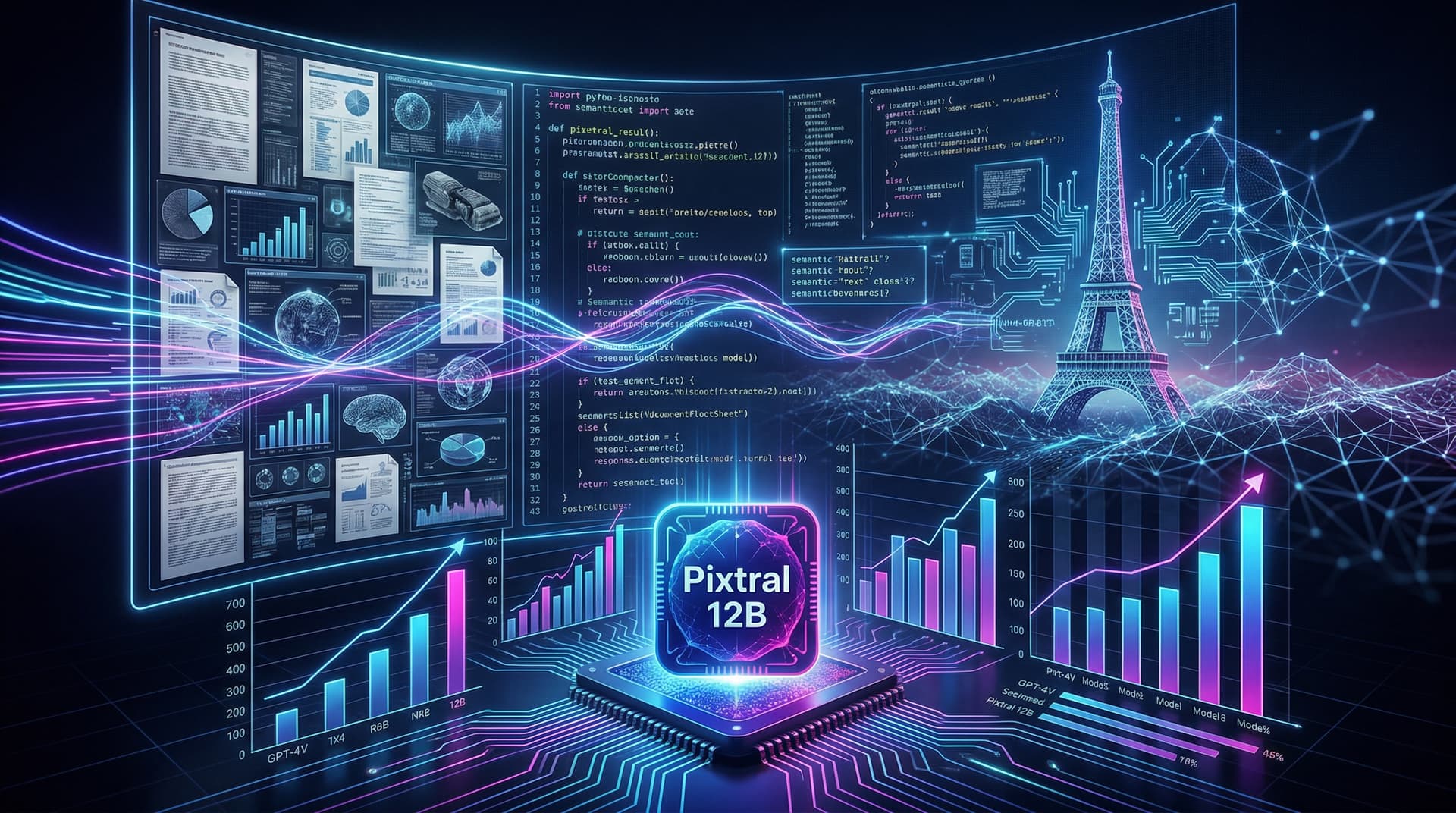
Paris, France – December 6, 2024 – In a bold move that's shaking up the AI industry, French startup Mistral AI has released Pixtral 12B, a 12-billion parameter open-weight multimodal model capable of processing both text and images with state-of-the-art performance. Announced on December 2, this model not only challenges closed-source behemoths like OpenAI's GPT-4V and Anthropic's Claude 3 series but also sets a new standard for open-source alternatives in vision-language understanding.
The Rise of Multimodal AI
Multimodal AI, which integrates multiple data types like text, images, and potentially audio, is the next frontier in artificial intelligence. While large language models (LLMs) like GPT-4 and Llama have dominated natural language processing, adding robust vision capabilities has proven challenging. Proprietary models from Big Tech have led the way, but their black-box nature limits accessibility for researchers, developers, and enterprises.
Mistral AI, founded in 2023 by former Google DeepMind and Meta researchers Arthur Mensch, Guillaume Lample, and Timothée Lacroix, has quickly risen to prominence with efficient, high-performing models like Mistral 7B and Mixtral 8x22B. With over €1 billion in funding from backers including Microsoft and Nvidia, the company is positioning itself as Europe's answer to American AI dominance. Pixtral 12B is their first foray into native multimodal territory, built from scratch rather than as an adapter on top of existing LLMs.
Key Features and Capabilities
Pixtral 12B supports a context window of up to 128,000 tokens, allowing it to handle extensive documents and high-resolution images (up to 1,024 x 1,536 pixels). It excels in a wide range of tasks:
- Document Understanding: Accurately extracts structured data from forms, tables, and invoices.
- Visual Question Answering (VQA): Answers complex queries about images, including OCR on handwritten text.
- Chart and Diagram Analysis: Interprets graphs, flowcharts, and mathematical diagrams.
- Object Detection and Counting: Identifies and enumerates multiple objects in cluttered scenes.
- Code Generation from Screenshots: Writes functional code based on visual representations of UIs or diagrams.
The model is licensed under Apache 2.0, making it fully open for commercial use. Weights and inference code are available on Hugging Face, with Mistral's La Plateforme offering hosted API access starting at low costs.
Benchmark-Beating Performance
Independent evaluations highlight Pixtral 12B's prowess. On the DocVQA benchmark (document visual question answering), it scores 90.7%, edging out GPT-4V (89.9%) and Claude 3.5 Sonnet (88.8%). In ChartQA, it achieves 89.2% versus GPT-4o's 86.4%.
| Benchmark | Pixtral 12B | GPT-4V | Claude 3 Haiku | Llama 3.2 11B | |-----------------|-------------|--------|----------------|---------------| | DocVQA | 90.7% | 89.9% | 83.0% | 78.2% | | ChartQA | 89.2% | 86.4% | 82.1% | 75.6% | | TextVQA | 85.6% | 84.2% | 80.5% | 72.9% | | MMBench-EN | 82.3% | 81.7% | 78.9% | 70.4% |
These results are remarkable for a 12B model, especially compared to larger closed models. Pixtral also shines in non-English tasks, scoring high on InfographicVQA-French (84.5%). Its efficiency is a standout: inference runs on consumer GPUs like the RTX 4090, democratizing access.
Technical Innovations Under the Hood
Pixtral leverages a vision encoder based on modern architectures, combined with Mistral's Nemo trunk for language processing. Trained on a massive dataset of image-text pairs, including synthetic data for edge cases, it avoids common pitfalls like hallucination in visual reasoning. The team's blog post details innovations in dynamic resolution handling and late fusion techniques, ensuring scalability without proportional compute increases.
Unlike vision adapters (e.g., LLaVA), Pixtral is natively multimodal, trained end-to-end. This results in better alignment between modalities, reducing errors in tasks requiring deep integration, such as mathematical reasoning from diagrams.
Industry Implications
This launch intensifies the open-source vs. closed-source debate. With Pixtral, developers can now build production-grade vision apps without vendor lock-in. Enterprises in finance (document automation), healthcare (medical imaging analysis), and e-commerce (visual search) stand to benefit.
Mistral's timing is strategic, coinciding with regulatory pressures in Europe under the AI Act. By prioritizing openness and efficiency, they align with calls for transparent AI. CEO Arthur Mensch stated, "Pixtral brings frontier multimodal capabilities to everyone, fostering innovation without barriers."
Competitors are responding: Meta's Llama 3.2 11B-Vision lags in benchmarks, while open models like Qwen2-VL are catching up. Expect forks, fine-tunes, and integrations with tools like LangChain soon.
Challenges and Future Outlook
Despite strengths, Pixtral has limitations. It struggles with fine-grained spatial reasoning and video (future roadmap item). Safety evaluations show low refusal rates on harmful prompts, prompting Mistral to recommend guardrails.
Looking ahead, Mistral teases larger models like Mistral Large 2 (123B parameters) and multimodal expansions. With Nvidia's backing and Paris as a hub, they're poised for global impact.
Pixtral 12B isn't just a model; it's a manifesto for open AI in the multimodal era. As we hit December 2024, this release underscores Europe's growing clout in the AI race.
CSN News is your source for cutting-edge tech insights. Follow for more on AI advancements.
(Word count: 912)