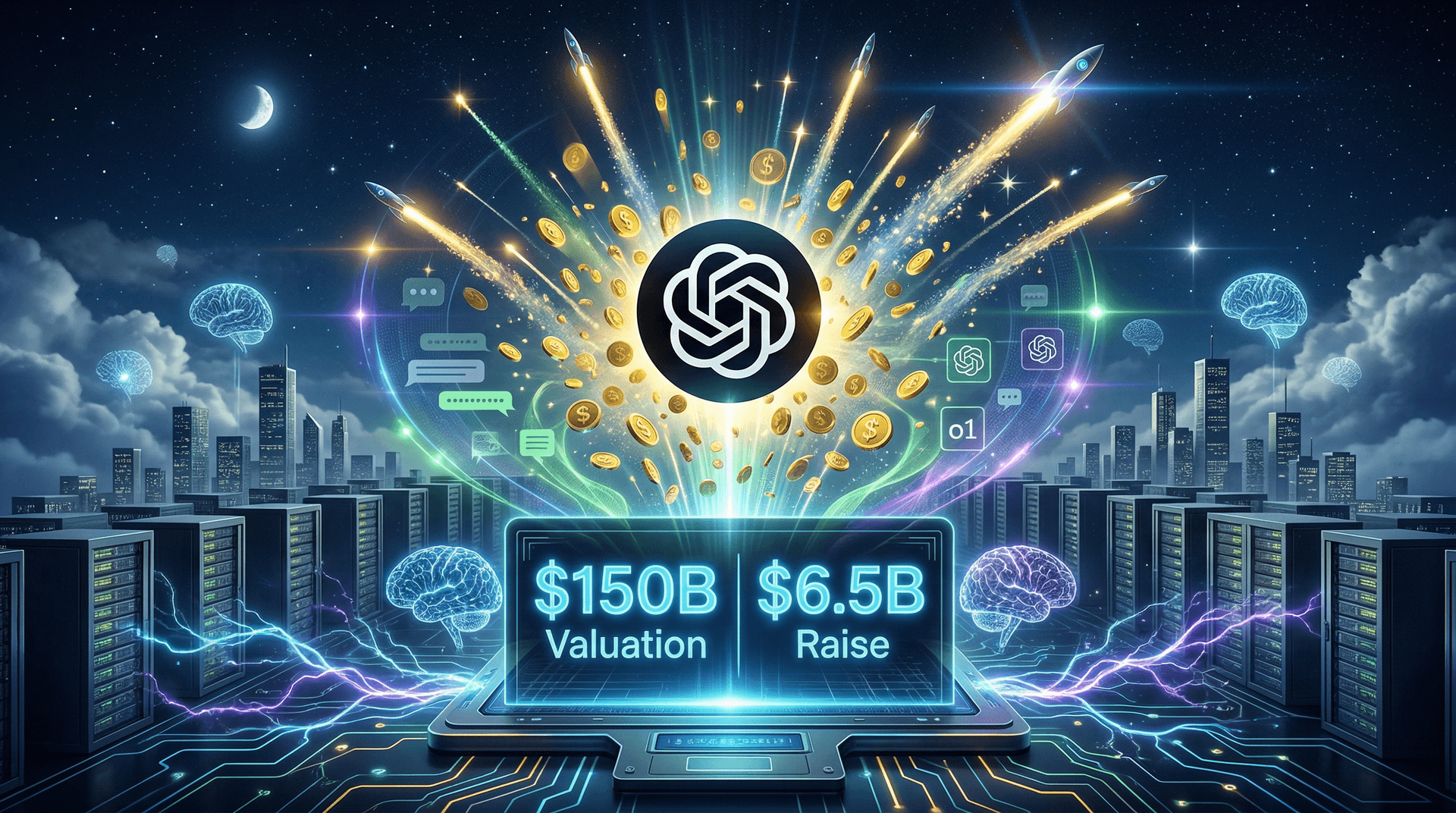
In a move that further cements its position as the undisputed leader in artificial intelligence, OpenAI is reportedly in discussions to secure a staggering $6.5 billion in fresh funding. According to a Wall Street Journal report on October 1, 2024, this round could propel the company's valuation to an eye-watering $150 billion—more than doubling its last known figure from earlier this year. This development arrives just months after the launch of its groundbreaking o1 reasoning model, highlighting the relentless demand from investors betting big on AI's transformative potential.
The Funding Frenzy in AI
OpenAI's journey from a nonprofit research lab to a commercial juggernaut has been nothing short of spectacular. Founded in 2015 by a consortium including Elon Musk, Sam Altman, and Greg Brockman, the organization pivoted to a capped-profit model in 2019 to attract capital for scaling its ambitious goals. Since ChatGPT's explosive debut in November 2022, which amassed over 100 million users in record time, OpenAI has become synonymous with generative AI.
Previous funding rounds paint a picture of accelerating growth. In 2023, the company raised $10 billion from Microsoft at a $29 billion valuation. By October 2024, that figure had climbed to around $80-90 billion in secondary share sales. Now, with this potential $6.5 billion infusion—led reportedly by investors like Thrive Capital, Microsoft, and possibly sovereign wealth funds—OpenAI is poised to eclipse traditional tech giants in market cap without even being publicly traded.
The terms of the deal remain fluid, but sources indicate investors would receive about 4.4% equity for their cash, aligning with the $150 billion post-money valuation. This isn't just about money; it's a vote of confidence in OpenAI's ability to navigate technical hurdles toward artificial general intelligence (AGI), the holy grail of AI research.
Technological Catalysts Driving the Valuation
At the heart of OpenAI's allure are its cutting-edge machine learning models. The September 2024 release of o1 and o1-mini introduced 'reasoning' capabilities, allowing the AI to 'think' step-by-step before responding, dramatically improving performance on complex tasks like math, coding, and science. Benchmarks showed o1-preview outperforming rivals on tough exams, scoring 83% on GPQA (a graduate-level science test) compared to GPT-4o's 74%.
This innovation builds on ChatGPT's foundation, powered by GPT-4 series models trained on vast datasets using transformer architectures—a cornerstone of modern deep learning. OpenAI's shift toward post-training techniques like reinforcement learning from human feedback (RLHF) has refined these systems, making them safer and more aligned with user needs.
Revenue is another booster. OpenAI reportedly hit $3.4 billion in annualized revenue by mid-2024, fueled by ChatGPT subscriptions ($20/month Plus tier), enterprise API access, and partnerships. Microsoft integration via Azure and Copilot has been lucrative, with analysts projecting $11 billion for 2024.
Competitive Landscape Heats Up
OpenAI isn't alone in the AI arms race. Rivals like Anthropic (valued at $18.4 billion after a $4 billion Amazon-led round) and xAI (Elon Musk's venture, backed by $6 billion) are scaling rapidly. Anthropic's Claude 3.5 Sonnet rivals o1 in coding and vision tasks, while xAI's Grok-2 leverages real-time X data for edge.
Google DeepMind's Gemini 1.5, with its massive 1 million token context window, and Meta's open-source Llama 3.1 (405B parameters) challenge OpenAI's moat. Yet, OpenAI leads in proprietary capabilities and brand recognition. The funding talks underscore fears of falling behind in the compute wars, where Nvidia GPUs are gold.
OpenAI's superalignment team, tasked with AGI safety, adds intellectual heft. Sam Altman's public musings on superintelligence resonate with venture capitalists, who see trillion-dollar opportunities in AI-driven automation across healthcare, finance, and beyond.
Market Reactions and Broader Implications
News of the talks rippled through markets. While OpenAI remains private, proxies like Microsoft (MSFT) saw modest gains, and Nvidia (NVDA)—the AI chip kingpin—continued its rally. Venture funding in AI startups hit $24 billion in Q3 2024 alone, per PitchBook, with OpenAI's round dwarfing most.
Critics, however, raise eyebrows. Regulatory scrutiny looms from the FTC and EU over monopolistic practices and data usage. Energy demands for training (o1 required immense compute) spark sustainability debates. Altman himself advocates for global governance, testifying before Congress in May 2024.
For machine learning practitioners, this capital influx means accelerated R&D. Expect advancements in multimodal AI (text+image+video), agentic systems (AI that acts autonomously), and efficiency gains via techniques like mixture-of-experts (MoE).
What Lies Ahead for OpenAI?
If finalized, the $6.5 billion would fund data centers, talent poaching (salaries top $1M), and model iterations. Rumors swirl of an AI-powered search engine and browser to challenge Google, plus expansions into hardware.
Altman's vision: democratize AGI while ensuring benefits outweigh risks. As he stated in a recent blog, "We're now confident we know how to build AGI as we have traditionally understood it." Investors are all-in.
This funding saga exemplifies AI's paradigm shift—from niche academia to trillion-dollar industry. As machine learning evolves, OpenAI's trajectory will shape our digital future.
CSN News, October 5, 2024. Word count: 912.