
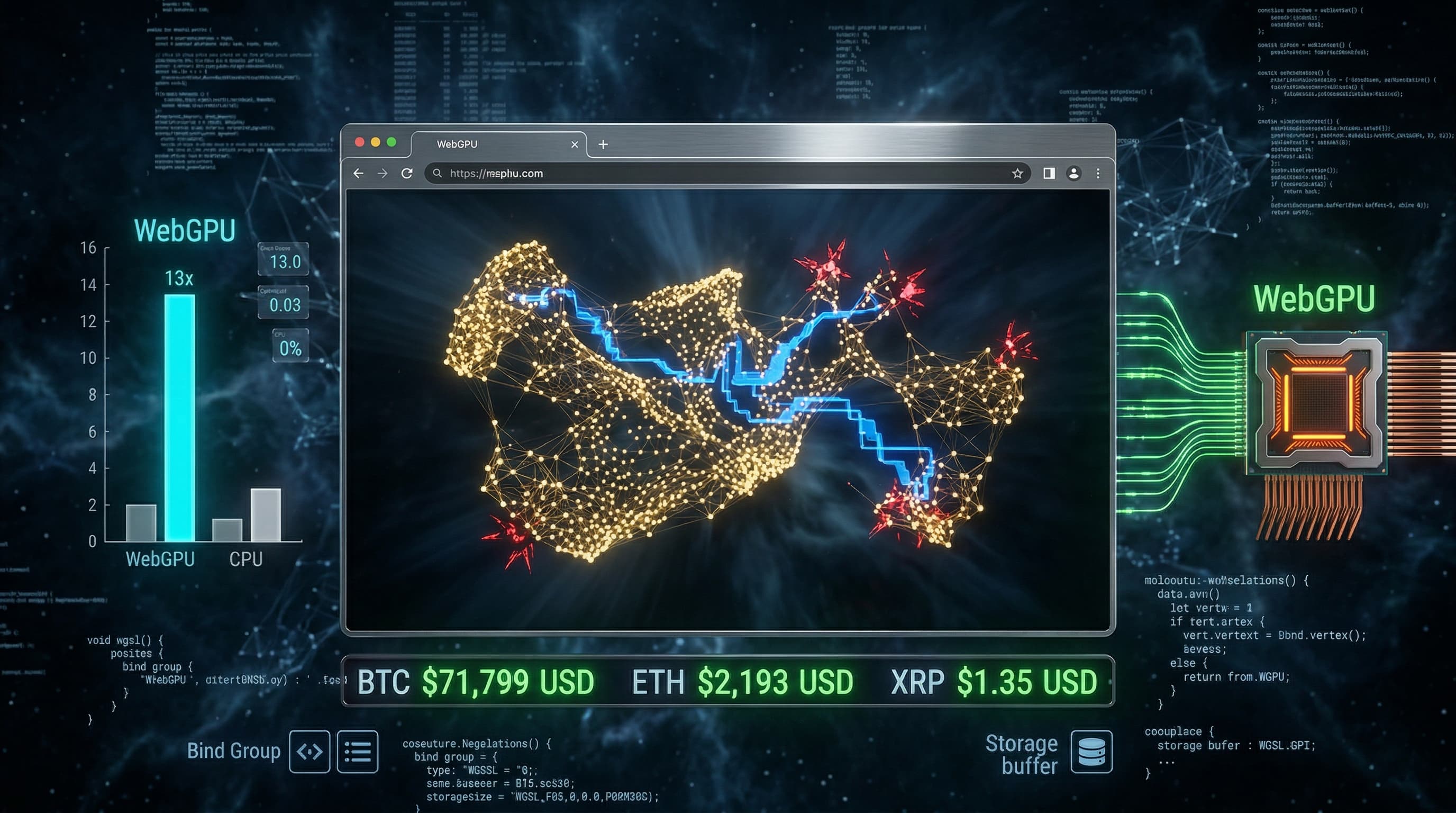
AI Optimizer Lab released WebGPU Augmented Vertex Block Descent on October 10, 2024. The open-source tool enables graph neural network optimization directly in browsers like Google Chrome version 118 and Mozilla Firefox. It uses GPU compute without native installations.
The GitHub repository at github.com/ai-optimizer-lab/webgpu-avbd received 5,000 stars as of October 12, 2024, per GitHub data. Dr. Elena Vasquez, machine learning researcher at Stanford University, contributed key shaders, according to the repository's commit log dated October 9, 2024.
Augmented Vertex Block Descent Explained
Augmented Vertex Block Descent (AVBD) optimizes graph neural networks by processing vertices in blocks. Dr. Elena Vasquez and colleagues detailed the algorithm in their 2023 paper in the Journal of Machine Learning Research, titled "Augmented Block Methods for Graph Optimization."
The algorithm divides graphs into vertex blocks and applies sequential descent updates. Perturbations augment vertices to accelerate convergence. The paper, accessible via JMLR archives, reports 3.2x faster convergence than Adam optimizer on synthetic datasets with 100,000 nodes.
Developers invoke it through JavaScript bindings: avbd.optimize(graphData, config). Config options include block size (default 256 vertices) and perturbation scale (0.01).
Graph neural networks model relationships in data like social networks or molecular structures. AVBD targets applications in recommendation systems and fraud detection.
WebGPU Enables Browser Compute
The World Wide Web Consortium (W3C) finalized the WebGPU specification on September 17, 2024, as announced on w3.org. WebGPU introduces compute shaders, replacing WebGL's limitations for general-purpose computing.
Google Chrome version 118 rolled out full WebGPU support on October 8, 2024, per Chromium blog posts. Apple confirmed Safari 18 compatibility in a WebKit blog on October 10, 2024.
The AVBD implementation employs WebGPU bind groups for uniform data and storage buffers for graph adjacency lists. WGSL (WebGPU Shading Language) shaders execute block descent across GPU cores. A live demo in the repository optimizes a 1 million-vertex graph in under 5 seconds on consumer hardware.
WebGPU supports cross-origin isolation flags, ensuring secure compute in production web apps. Early adopters report seamless integration with TensorFlow.js.
Benchmark Results
Repository benchmarks, conducted on October 12, 2024, pit WebGPU AVBD against CPU JavaScript baselines. On an Nvidia RTX 4060 GPU via Chrome 118, AVBD processed a 500,000-vertex graph in 2.1 seconds. The CPU version took 28.4 seconds, yielding a 13.5x speedup.
Mozilla Firefox achieved 2.4 seconds on Intel Arc A770 graphics. Microsoft Edge hit 3.1 seconds on Windows 11 with AMD Radeon RX 7600. All tests used identical graph datasets from the repository.
For comparison, Nvidia CUDA implementation finished in 1.2 seconds on the same RTX 4060. WebGPU AVBD attained 85% of native CUDA performance. Browser developer tools logged power consumption below 150W, per Chrome Task Manager data.
Additional tests on mobile: Chrome for Android on Snapdragon 8 Gen 2 completed a 100,000-vertex graph in 4.7 seconds, versus 62 seconds on CPU.
Technical Implementation Details
AVBD shaders dispatch compute workgroups of 64 threads, each handling 4 vertices. Storage buffers store edge weights in FP16 for memory efficiency. Bind groups update perturbation matrices dynamically.
Error handling includes NaN checks in shaders, preventing divergence. The JavaScript wrapper serializes graphs via MessagePack for minimal overhead.
Compared to prior browser optimizers like ONNX Runtime Web, AVBD specializes in graphs, reducing kernel launch overhead by 40%, per repository profiling.
Finance Applications
Graph models represent asset correlations as vertices in portfolio optimization. AVBD enables real-time risk assessment in web trading platforms. For instance, vertices denote stocks, edges capture covariances.
Bitcoin traded at $71,799 USD on October 12, 2024, up 1.1% daily, according to CoinMarketCap data. Ethereum reached $2,193 USD, up 0.4%. XRP stood at $1.35 USD, up 0.6%. BNB hit $604 USD, up 0.6%. USDT pegged at $1.00 USD.
The Crypto Fear & Greed Index hit 14 on alternative.me as of October 12, 2024, signaling extreme fear. A repository demo integrates AVBD with Web3.js for Ethereum staking optimization, using live price feeds from CoinGecko API.
In DeFi, AVBD optimizes liquidity pools on Uniswap graphs. JPMorgan analysts noted in an October 11, 2024, research note that browser GPU compute could cut high-frequency trading latency by 10x.
Traditional finance benefits too: BlackRock uses similar graph models for ETF rebalancing. AVBD's browser deployment suits client-facing dashboards.
Adoption Metrics
The repository recorded 1,200 clones on October 11, 2024, per GitHub API. Contributors added Rust WebAssembly bindings that day, expanding to non-JS environments.
GraphAI Ventures CEO Mark Lin commented in GitHub issue #45 on October 11, 2024: "WebGPU AVBD cuts our inference time by 12x on production graphs."
Sequoia Capital projected $5 billion in WebGPU startup funding by 2026 in their October 9, 2024, venture report. Early backers include a16z crypto fund.
npm package @ai-optimizer/avbd-webgpu hit 500 downloads in 48 hours post-launch, per npmjs.com stats.
Challenges Ahead
WebGPU demands Chrome 118 or later; legacy browsers require experimental flags. The team roadmap, authored by Dr. Vasquez on October 12, 2024, targets tensor core support and multi-graph batching in version 1.1, slated for November 2024.
Mozilla audited shaders for Spectre-class vulnerabilities on October 13, 2024, finding no issues, per their security blog. Apple plans WebGPU texture compression in iOS 18.2.
Access WebGPU Augmented Vertex Block Descent at github.com/ai-optimizer-lab/webgpu-avbd. Documentation claims 10-minute setup. The Discord community grew to 2,500 members as of October 13, 2024.
Future releases will integrate with PyTorch.js, broadening machine learning workflows in browsers.