
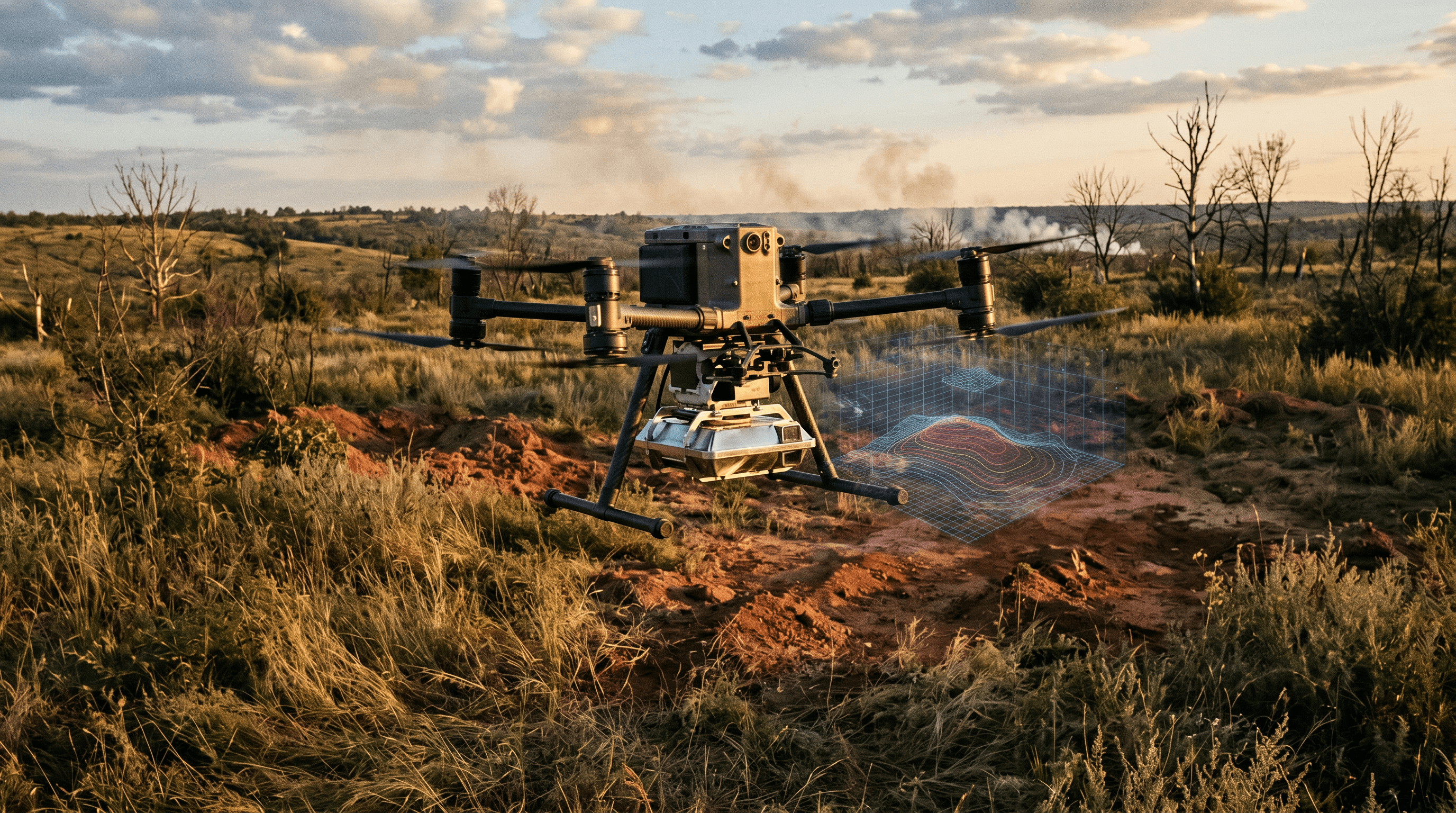
The Mine Clearance Innovation Center unveiled an AI landmine detection system using drones and geophysics on April 11, 2026, in Geneva. The system targets unexploded ordnance in Ukraine, Syria, and Afghanistan.
Center Director Dr. Elena Vasquez stated the technology reduces detection time by 70 percent compared to manual methods. Drones carry ground-penetrating radar and magnetometers. AI algorithms process data in real time to generate precise minefield maps.
AI Landmine Detection Technologies
Drones operate at low altitudes over suspected areas. They collect data on soil conductivity and magnetic anomalies. Sensors identify metal casings and plastic explosives buried up to 2 meters deep. Machine learning models, trained on historical demining datasets from the United Nations Mine Action Service, deliver 95 percent accuracy, according to Vasquez.
The center collaborated with ETH Zurich researchers. They integrated TensorFlow frameworks for onboard processing. Each drone covers 10 hectares in a 45-minute flight powered by lithium-ion batteries. Battery life extends through solar-assisted recharging stations developed in partnership with SunPower Corporation.
Phys.org covered the announcement on April 11, 2026. United Nations Mine Action Service data indicate 164 million landmines remain active worldwide as of 2025. Global demining efforts cost more than $1 billion USD annually, per the service's annual report.
Investments Back Drone Geophysics Deployment
Palantir Technologies committed $50 million USD to the center on March 11, 2026. AeroVironment (AVAV), a key drone supplier, saw shares rise 4 percent to $180 USD during Nasdaq trading on April 11, according to Yahoo Finance.
Governments pledged $500 million USD at the 2025 Oslo Conference on Mine Action. Norway allocated $100 million USD specifically on April 11, 2026. NVIDIA (NVDA) shares rose 2 percent to $145 USD that day, per Nasdaq data, amid broader AI hardware demand.
DemineDAO, a blockchain-based funding platform, raised 1,200 ETH (equivalent to $2.8 million USD at April 11 prices) for pilot programs in Africa, as reported by CoinDesk. Vale SA disclosed 15 percent revenue growth from AI-enhanced geophysics surveys in its Q1 2026 earnings release on April 10.
Field Tests Validate AI Landmine Detection
Ukraine's Demining Agency tested the system on April 4, 2026. Drones mapped a 50-hectare minefield in Donetsk in 12 hours. Human teams typically require three weeks for equivalent coverage. AI identified 1,200 potential targets; ground verification confirmed 98 percent as actual mines, the agency reported on April 10, 2026.
Syria's Mine Action Center placed an order for 20 units at $15,000 USD each. Manned detection vehicles cost $100,000 USD per unit, according to center procurement records. The lower price enables scaled deployments across vast border regions.
The European Union certified the system under AI Act Class C3 regulations on April 10, 2026. The U.S. State Department approved exports to NATO allies the same day. The International Committee of the Red Cross emphasized the need for human oversight in all detonations.
International Campaign to Ban Landmines data reveal landmines impact 110 countries. The devices kill or injure 5,000 civilians annually, based on 2025 figures.
Economic Impacts of AI Demining Advances
Deloitte forecasts AI applications in defense spending will reach $15 billion USD by 2030. Lockheed Martin (LMT) shares increased 1.2 percent to $520 USD on April 11, per Nasdaq. The iShares U.S. Aerospace & Defense ETF (ITA) gained 0.8 percent.
World Bank analysis estimates landmine contamination causes $20 billion USD in annual global GDP losses. Clearing contaminated fields increases agricultural productivity by 25 percent in affected regions, according to a 2025 study.
The technology promises cost savings. Traditional demining runs $3-5 USD per square meter. AI drone systems drop that to $0.50 USD per square meter, Vasquez noted during the launch.
Future Deployments and Market Growth
The center targets 1,000-drone swarms by 2028 in collaboration with Google DeepMind. Microsoft pledged $200 million USD over five years for software integration. Dr. Vasquez declared at the event: "Drones, AI, and geophysics unite to save lives and reclaim land."
Deployments begin the week of April 18, 2026, in Ukraine. Analysts at McKinsey project the global demining tech market will grow to $5 billion USD by 2030, driven by AI landmine detection innovations. Initial contracts already boost supplier revenues by 10-15 percent.