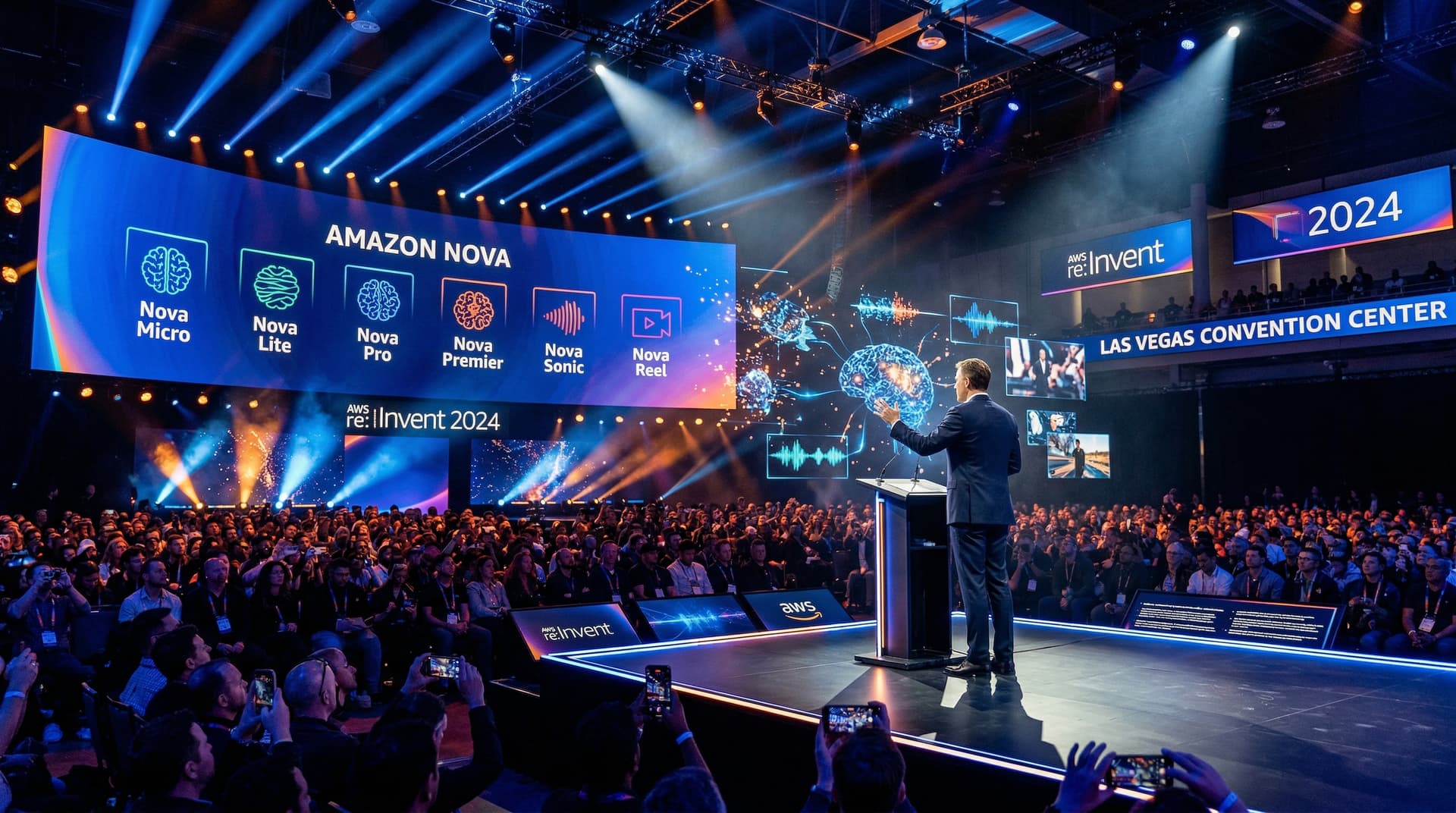
Las Vegas, December 3, 2024 – Amazon Web Services (AWS) has made a bold entry into the competitive frontier of foundation models with the announcement of Amazon Nova, a new family of AI models unveiled during the keynote at its flagship re:Invent 2024 conference. Delivered by AWS CEO Matt Garman on December 2, the news sent ripples through the tech industry, signaling Amazon's intent to challenge incumbents like OpenAI, Anthropic, and Google with models that prioritize performance, efficiency, and affordability.
The Nova Family: Tailored for Every Use Case
The Nova lineup is structured into several variants, each optimized for specific workloads:
- Nova Micro: A lightweight model ideal for low-latency applications. It supports a 128K token context window and excels in tasks like classification, summarization, and extraction. Priced at just $0.035 per million input tokens, it's positioned as an ultra-efficient option for high-volume inference.
- Nova Lite: Multimodal capabilities for text and image inputs, making it suitable for visual question-answering and content generation. It balances speed and quality for real-time applications.
- Nova Pro: The workhorse for complex reasoning, coding, and agentic workflows. It outperforms models like Llama 3.1 405B and GPT-4o Mini on key benchmarks such as HumanEval and MMLU, while being up to 75% cheaper than comparable frontier models.
- Nova Premier: The flagship, state-of-the-art model set for release in early 2025. It promises to rival or surpass the most advanced models available today, with capabilities in long-context reasoning and multimodal processing.
Additionally, AWS introduced specialized models:
- Nova Sonic: A speech-to-speech foundation model for natural conversations, supporting real-time voice interactions without transcription latency.
- Nova Reel: A text-to-video model generating high-quality clips up to 10 seconds long, aimed at creative and marketing applications.
These models will be available through Amazon Bedrock, AWS's fully managed service for building and scaling generative AI apps, ensuring seamless integration with existing cloud workflows.
Benchmark-Beating Performance at Fraction of the Cost
AWS emphasized empirical superiority in its demos and benchmarks. Nova Pro, for instance, achieved a 92% score on HumanEval (coding) versus GPT-4o Mini's 87%, and 84.8% on MMLU (general knowledge) compared to Llama 3.1 405B's 83.5%. Pricing is a standout: Nova Pro input at $0.22 per million tokens is 75% less than GPT-4o Mini, with output even more economical.
"We're not just building models; we're building the infrastructure for the next wave of AI innovation," Garman stated during the keynote. This cost-performance edge is crucial as enterprises grapple with ballooning AI expenses amid economic pressures.
Beyond Models: Agents and Developer Tools
The announcements extended to agentic AI. Amazon Bedrock Agents now support customizable knowledge bases and third-party tool integrations, enabling autonomous task execution. A highlight was Amazon Q Developer, an enhanced coding agent that can now handle multi-file edits, testing, and documentation directly in IDEs like VS Code and JetBrains.
AWS also previewed Nova Act, an agent framework for building multi-step AI workflows, and integrated Anthropic's Claude 3.5 Haiku – the fastest Claude model yet – into Bedrock.
Hardware Synergy: Trainium3 and Inferentia2
Complementing the software push, AWS revealed AWS Trainium3, the next-gen AI training chip delivering 40% more inference performance per watt than NVIDIA's H100. Inferentia2 clusters scale to 20,000 chips for massive workloads. These chips power Nova training, ensuring AWS controls the full stack.
Industry Implications and Competition
This launch comes at a pivotal moment. OpenAI's recent o1 reasoning models and Google's Gemini 2.0 have raised the bar, but Nova's focus on enterprise-grade reliability, data privacy (no training on customer data), and regional availability addresses key pain points for businesses.
Analysts praise the move. "AWS is leveraging its cloud dominance to democratize frontier AI," said Forrester's Mike Gualtieri. However, skeptics note that while benchmarks impress, real-world deployment will be the true test.
Competitors reacted swiftly. Shares of AWS parent Amazon (AMZN) rose 2% in after-hours trading, while NVIDIA dipped slightly amid chip rivalry talks.
What's Next for AWS AI?
re:Invent continues through December 6, with more sessions on security (e.g., Amazon Security Lake GA) and edge computing. Early access to Nova models begins immediately for select customers, with general availability rolling out in weeks.
For developers, the message is clear: AWS is all-in on making AI accessible, scalable, and profitable. As Garman put it, "The future of AI is built on AWS."
This positions Amazon not just as a cloud provider, but as an AI powerhouse. Stay tuned for hands-on reviews and deeper benchmarks as Nova hits production.
CSN News will continue coverage from re:Invent, including interviews with AWS execs and partner demos.
(Word count: 912)