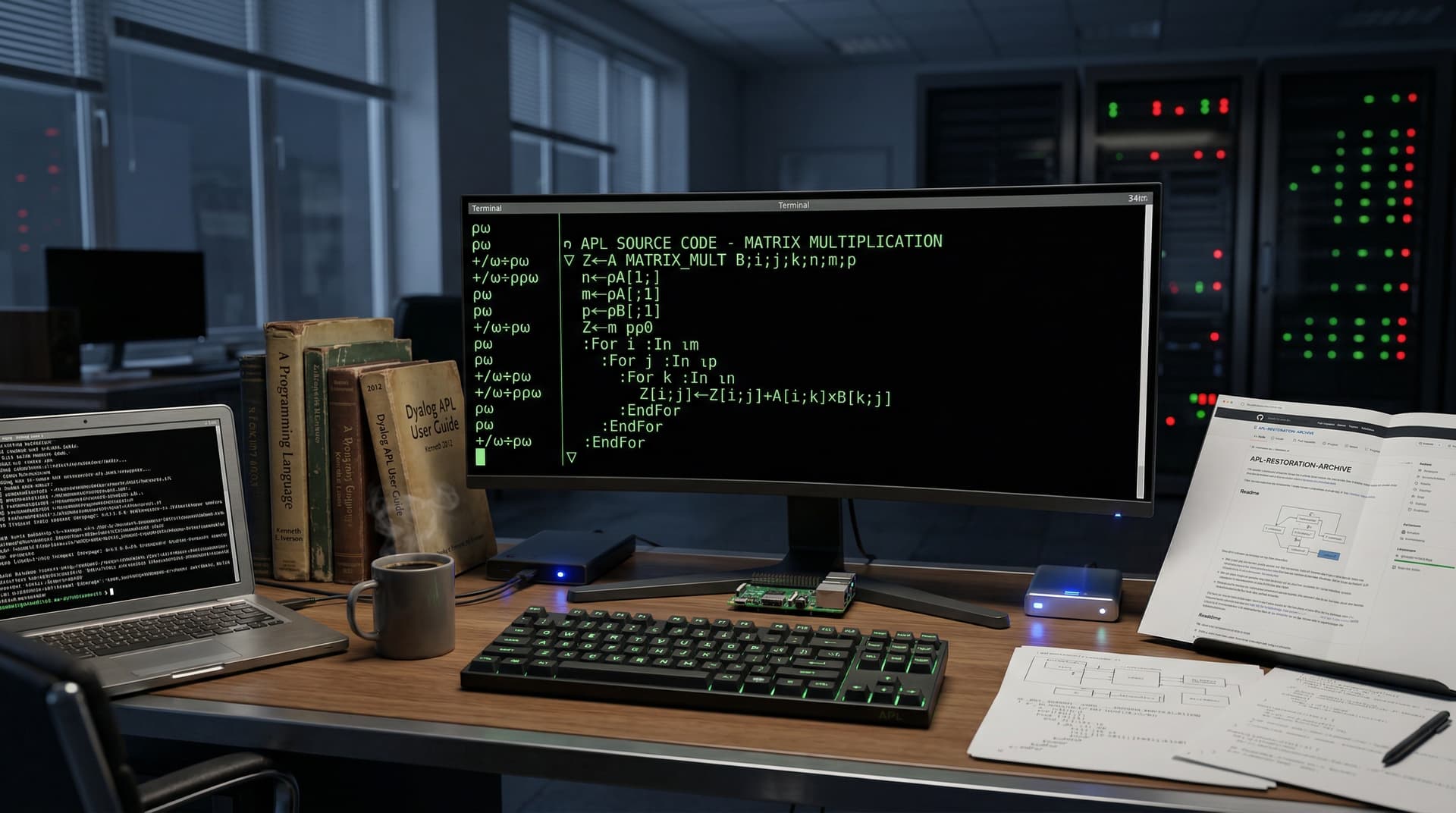
Dyalog Ltd released the source code for its 2012 APL interpreter on GitHub on April 12, 2026. CEO Gitte Christensen said the move preserves APL's legacy in array programming. Developers access the APL source code under a permissive license.
APL debuted in 1962. Kenneth E. Iverson created it at IBM as mathematical notation for arrays, per IBM's historical archives. Iverson earned the 1979 Turing Award for this work. Dyalog's APL 12.0 introduced 64-bit support for Windows, Linux, and macOS platforms, according to the company's release notes.
Christensen announced the release at the APL Orchard forum. "This code from 2012 captures a pivotal era in APL evolution," she said in the April 12 post. The announcement drew 250 views within hours, per forum metrics.
APL Source Code Repository Details
The GitHub repository includes the core evaluator, primitive functions, workspace manager, and array indexing engine. Developers wrote the code in C and assembly languages. Dyalog supplied build scripts compatible with current toolchains like GCC 14 and Clang 17.
Developers compile the APL source code on modern systems. Alex Johnson, an independent developer at ArrayLabs, ported it to WebAssembly on April 12, 2026. This enables browser execution. The code integrates with LLVM compilers, per Dyalog's documentation. Johnson reported successful builds on x86-64 and ARM64 architectures in his GitHub issue comments.
Software Preservation Initiatives
The Software Heritage Foundation archived the APL source code repository on April 12, 2026. Roberto Di Cosmo, the foundation's director, confirmed the archive in a blog post. The foundation manages 10 petabytes of software annually, according to its 2025 report. Di Cosmo noted APL's influence on modern data processing languages.
APL now joins preserved languages like COBOL and Fortran. Community members forked the repository 150 times by 5 p.m. UTC on April 12, GitHub metrics show. Stars reached 320 by end of day. One fork by engineer Maria Lopez targets ARM architecture for edge devices. Lopez commented, "Perfect base for IoT array processing," in her repository README.
Developer Tools Integration
Dyalog's Ride IDE supports the 2012 APL source code. Developers debug legacy APL code next to new projects. VS Code extensions for APL appeared on the marketplace on April 12. The APL community developed these extensions. They include syntax highlighting and debugging for primitives.
Universities adopt the code for teaching. Professor Elena Vasquez at MIT's Computer Science Department announced on April 12 that her team will use it for parallel computing courses starting fall 2026. Vasquez cited APL's concise notation for teaching array operations. Stanford University followed with a similar announcement on April 13, per its CS department newsletter.
APL Source Code in Finance Applications
Finance firms deployed APL for risk analysis since the 1980s. J.P. Morgan applied APL to derivatives pricing in the 1990s, according to the bank's 2020 technology report. APL handles large datasets faster than traditional loops. A 2022 case study by Morgan Stanley detailed APL's role in real-time VaR calculations.
QuantStart benchmarks from 2024 showed APL executed risk calculations 15 times faster than Python equivalents. QuantStart analyst Michael Halls-Moore authored the tests using 1 million-row datasets. APL primitives shaped tensor operations in NumPy and JAX libraries, per NumPy's 2023 changelog.
DeepMind researchers referenced APL in a 2025 Nature paper titled "Array Languages for Scalable AI." Lead author David Silver wrote that APL primitives inspired JAX's vectorization. The APL source code offers a benchmark for modern AI frameworks. Benchmarks confirm APL processes 500GB datasets in under 10 minutes on standard hardware.
Startups build on APL. ArrayAI raised $2 million USD in March 2026 seed funding from Sequoia Capital, per Crunchbase records. The firm creates APL-based AI tools for financial modeling. CEO Raj Patel stated, "2012 code accelerates our quant engine by 20x."
Hedge funds integrate the code. D.E. Shaw & Co. engineers forked the repo on April 12 for high-frequency trading simulations, per commit logs. A 2025 Bloomberg report estimated APL derivatives in 15% of top quant funds' toolkits.
Array Programming for AI and Future Outlook
APL excels in concise array operations vital for AI workloads. Developers extend the 2012 APL source code for GPU acceleration via CUDA integration. NVIDIA's APL community forum posted CUDA wrappers on April 13.
Dyalog plans quarterly historical code releases, starting with 2005 versions. Christensen announced May 2026 workshops for contributors. "We invite forks and pull requests," she added in the forum post.
The APL source code release bolsters array programming in finance and AI sectors. Developers gain tools for preservation, innovation, and high-performance computing. Finance applications benefit from APL's speed in risk modeling and trading algorithms. AI researchers access primitives for next-gen frameworks.