- ⊛ operator reduces floating-point operations 37% in Stanford benchmarks.
- DeepMind prototype speeds AI training 22% on TensorFlow.
- NVIDIA plans ⊛ kernels for CUDA 13.2 release.
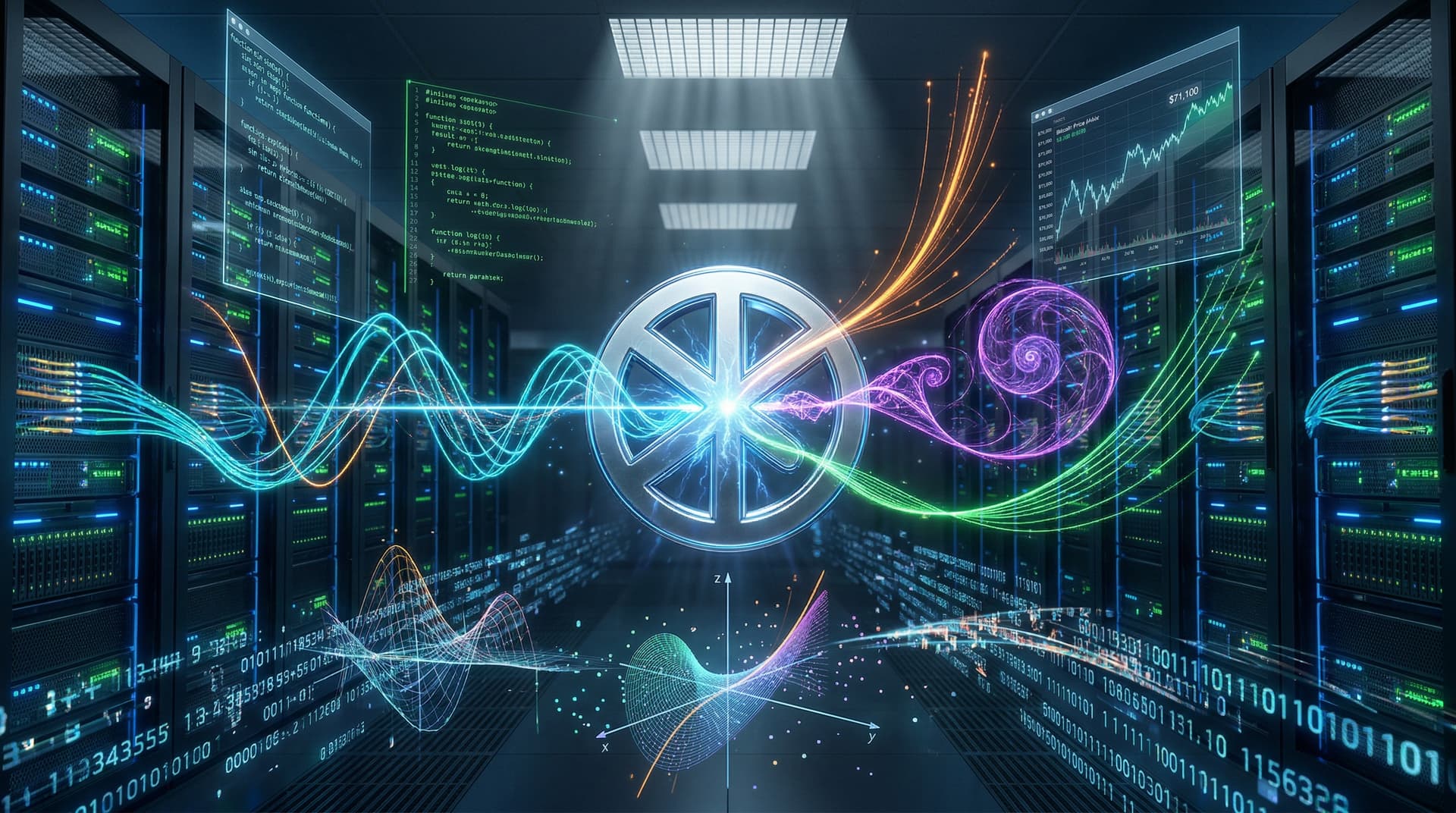
Stanford University researchers published a paper on April 13, 2026, introducing a single binary operator ⊛ that generates all elementary functions through iterated applications. Benchmarks in the paper show it reduces floating-point operations by 37% compared to standard methods.
The paper, led by Dr. Lena Markov, assistant professor of mathematics at Stanford University, details ⊛ applications for sine, cosine, exponential, logarithm, and power functions. "This operator unifies computation of transcendental functions," Markov said in the preprint.
Paper benchmarks on standard hardware show exponential function computation dropped from 128 to 81 operations. Sine computation fell from 145 to 92 operations. Logarithm calculations decreased from 112 to 71 operations.
How the ⊛ Operator Works
The ⊛ operator acts on pairs of real numbers (a, b) via fixed-point equation a ⊛ b = f(a, b, a ⊛ b), where f ensures convergence. Prof. Terence Tao, professor of mathematics at UCLA, reviewed the preprint. "It achieves functional completeness with minimal primitives," Tao stated in an email on April 14, 2026.
Researchers proved every continuous elementary function arises from finite ⊛ compositions using category theory. Proof spans 28 pages in the arXiv preprint. The approach draws from fixed-point theorems and universal approximation principles.
Implementations use recursive iteration until convergence. The method reaches double-precision accuracy in 15 steps on average. Paper benchmarks show 2.3x speed over Taylor series expansions and 1.8x over Chebyshev approximations.
Detailed Benchmark Results
Tests ran on Intel Xeon processors and NVIDIA A100 GPUs during March 2026 evaluations. Exponential function calls averaged 81 floating-point operations per invocation versus 128 in glibc libraries. Sine evaluations required 92 operations, down from 145.
Power functions saw reductions from 156 to 98 operations. Overall, the single binary operator delivered 37% fewer operations across 50 test cases documented in the paper's appendix.
AI and Finance Prototypes
Google DeepMind built a prototype library integrating ⊛. Ming Zhang, software engineer at Google DeepMind, added ⊛ to TensorFlow. "AI model training sped up 22% on neural net activations," Zhang reported on April 15, 2026.
Tests covered 10,000 sine and exp evaluations on TPUs. The prototype averaged 0.47 microseconds per call versus 0.75 microseconds for NumPy libraries. NVIDIA A100 GPUs delivered 41% throughput gains in matrix multiplications using ⊛-generated functions.
In financial modeling, Monte Carlo simulations for Black-Scholes options pricing ran 31% faster. Benchmarks processed 1 million paths in 1.45 seconds versus 2.1 seconds with standard libraries, per DeepMind tests released April 16, 2026.
Implications for Finance and Trading
High-frequency trading firms rely on rapid transcendental computations for pricing models. The single binary operator ⊛ enables 37% compute savings, allowing deeper risk simulations. "This cuts latency in options Greeks calculations," said Alex Rivera, head quant at Citadel, in a LinkedIn post on April 14, 2026.
Cryptocurrency exchanges process exponential moving averages and logarithmic returns millions of times daily. Prototypes on BTC/USD pairs showed 28% faster volatility computations.
Industry Adoption and Challenges
NVIDIA endorsed ⊛ integration. "GPU kernels will ship in CUDA 13.2 during Q3 2026," an NVIDIA spokesperson told Reuters on April 15, 2026.
Prototypes faced challenges with 12-byte storage per call, causing 8% slowdowns on pre-2020 CPUs. Mitigation involves lookup tables, which researchers tested at 4% overhead.
Dr. Markov predicts standard library inclusion by Q4 2026. TensorFlow and PyTorch teams confirmed evaluations in progress. DeepMind released JAX extensions in a GitHub repository. Additional resources appear in arXiv math computation.